

Telling an AI to “Act as an Expert” Changes Everything
Artificial intelligence has become part of everyday work. People use it to write emails, create blog posts, build websites, answer customer questions, and even generate business ideas. But many people still get average results from AI because of one simple mistake.
They ask weak questions.
If you type something basic like “write an article about marketing,” the response may sound generic, repetitive, or shallow. But when you change your instruction and tell the AI to “act as an expert,” the quality of the answer often improves immediately.
That small change can completely shift the way the AI responds.
In this article, we’ll look at why this works, how it changes the output, and how you can use this technique to get better results for business, content writing, development, SEO, customer service, and more.
Why AI Responses Depend on Your Instructions
AI tools do not think like humans. They do not automatically know what type of answer you expect.
The AI studies your words and tries to predict the best possible response based on your request. This means the quality of your prompt directly affects the quality of the output.
When your instructions are unclear, the response becomes broad and generic.
For example:
Weak Prompt
“Write something about web design.”
This gives the AI almost no direction.
Now compare it with this:
Better Prompt
“Act as an experienced web designer with 15 years of experience. Write a professional article for small business owners about modern web design trends in 2026 using simple language.”
The second prompt provides:
- A role
- Experience level
- Audience type
- Writing tone
- Topic focus
- Language style
That extra context changes everything.
What Happens When You Say “Act as an Expert”
When you tell AI to act as an expert, you guide the system toward a specific style of thinking and communication.
The AI starts producing responses that sound
- More confident
- More organized
- More detailed
- More professional
- More focused on the topic
Instead of giving surface-level information, it usually provides deeper insights and better structure.
This works because the AI begins matching patterns from expert-level content it has learned from books, articles, interviews, and professional discussions.
It is similar to giving directions to a person before asking them to complete a task.
If you tell someone: ,“Write about cars.” The result may be random.
But if you say:
“Write like a professional automotive reviewer explaining fuel efficiency to first-time car buyers.” The answer becomes far more useful.
AI works in a similar way.
The Difference Between Normal Prompts and Expert Prompts
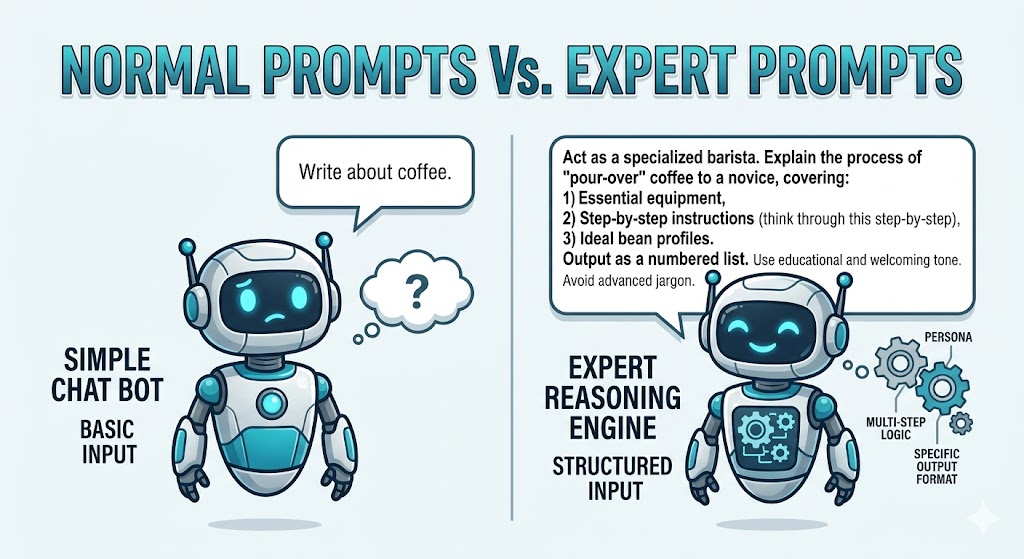
Here’s a simple comparison.
Basic Prompt
“Write a blog about coffee.”
Possible Result
- Very general
- Repetitive points
- Weak examples
- Little depth
Now look at this version.
Expert Prompt
“Act as a professional coffee shop owner with 15 years of experience in the specialty coffee industry. Write a beginner-friendly blog about different types of coffee and how to choose the right coffee based on taste preferences.”
Better Result
- Clear explanations
- Better structure
- Realistic advice
- Audience-focused writing
- More professional tone
The AI now understands:
- Who it is supposed to be
- What type of coffee knowledge is needed
- Who the article is written for
- What writing style to follow
- What value the reader expects
That is why the output becomes more detailed, useful, and easier to read.
Why Businesses Are Using Expert-Based AI Prompts
Businesses are starting to realize that AI is not just about automation. It is also about communication quality.
A poorly written AI response can damage trust. A well-written one can save time and improve productivity.
Companies now use expert prompts for:
- Marketing content
- Website copy
- Customer support
- Product descriptions
- Sales emails
- SEO blogs
- Technical documentation
Instead of asking AI random questions, teams are giving it clear professional roles.
For example:
- “Act as a senior copywriter.”
- “Act as a legal consultant.”
- “Act as a cybersecurity specialist.”
- “Act as a WordPress developer.”
- “Act as a business strategist.”
These prompts help create responses that match professional expectations.
How Expert Prompts Improve Content Writing
Content writing is one of the biggest areas where expert prompts make a huge difference.
Without guidance, AI-generated content can sound robotic or repetitive. But when you assign expertise and audience intent, the writing becomes much more natural.
Example Without Expert Guidance
“Write about social media marketing.”
The result may contain:
- Generic definitions
- Repeated advice
- Weak structure
Example With Expert Guidance
“Act as a digital marketing expert helping small businesses grow online. Write a practical guide about social media marketing using simple language and real-world examples.”
Now the content becomes:
- Easier to read
- More targeted
- More useful
- More engaging
This is especially important for SEO blogs because search engines reward helpful content that answers user intent clearly.
Expert Prompts Help AI Understand Tone
One of the biggest problems people face with AI writing is tone.
Sometimes the content sounds too formal. Other times it sounds unnatural or overly robotic.
Adding expertise instructions helps fix this problem.
For example:
Prompt
“Act as a friendly financial advisor explaining budgeting tips to young families.”
This tells the AI:
- The personality to follow
- The level of professionalism
- The target audience
- The communication style
As a result, the answer feels more human and relatable.
Better Prompts Lead to Better SEO Content
SEO content depends heavily on clarity and search intent.
If your AI prompt is vague, the article may fail to rank because it does not properly answer user questions.
Expert prompts improve SEO content because they encourage:
- Better topic coverage
- Stronger headings
- Clear explanations
- Improved readability
- Audience-focused writing
For example:
Weak SEO Prompt
“Write about website speed.”
Strong SEO Prompt
“Act as a technical SEO expert. Write an SEO-optimized article about how website speed affects Google rankings and user experience for small business websites.”
The second version gives the AI much better direction.
This usually produces content with:
- Better keyword relevance
- More organized structure
- More useful information
- Higher engagement potential
Expert Prompts Are Helpful for Developers Too
Developers also use expert prompting techniques to improve AI-generated code and technical explanations.
Instead of saying:
“Fix this code.”
Many developers now write prompts like:
“Act as a senior full-stack developer experienced in Angular and .NET. Review this code and explain the issue step by step.”
That small adjustment often leads to:
- Cleaner solutions
- Better debugging
- More accurate explanations
- Improved code quality
AI responds better when it understands the technical role it should follow.
The Psychology Behind Expert Prompts
There is an important reason why expert prompts work so well.
AI systems generate responses by predicting patterns based on the information they were trained on. When you mention an expert role, the AI begins pulling from patterns associated with professional-level communication.
For example:
- Doctors explain things differently than marketers.
- Lawyers structure information differently than teachers.
- Senior developers communicate differently than beginners.
Your prompt activates those patterns.
That is why even a few extra words can completely change the response quality.
Common Mistakes People Make When Using AI
Many users still struggle with AI because they:
- Use extremely short prompts
- Give no context
- Ignore audience type
- Forget tone instructions
- Ask multiple unrelated questions together
Here’s an example of a poor prompt:
“Write blog.”
The AI has no idea:
- What topic you want
- Who the audience is
- What tone to use
- How long it should be
- What goal the article should achieve
Now compare it with this:
“Act as an experienced business writer. Write a 1500-word blog for startup owners explaining how AI improves customer service. Use easy language and professional tone.”
That is a complete instruction.
The AI now has a roadmap.
How to Create Strong Expert Prompts
You do not need complicated prompt engineering skills to get better results.
You simply need to include a few important details.
1. Define the Role
Tell the AI who it should act as.
Examples:
- SEO expert
- Lawyer
- Teacher
- Web developer
- Business consultant
2. Mention Experience Level
This helps shape the depth of the answer.
Examples:
- “with 10 years of experience”
- “senior consultant”
- “experienced professional”
3. Define the Audience
Tell the AI who will read the content.
Examples:
- Small business owners
- Beginners
- College students
- USA-based customers
- Developers
4. Set the Tone
This controls how the writing feels.
Examples:
- Friendly
- Professional
- Conversational
- Technical
- Simple
5. Explain the Goal
Tell the AI what you want the final result to achieve.
Examples:
- Educate readers
- Improve SEO
- Increase sales
- Simplify technical topics
Real-World Example of an Effective Prompt
Here’s a strong example:
“Act as a professional SEO strategist with 12 years of experience. Write a beginner-friendly article for small business owners about why local SEO matters in 2026. Use simple language, proper headings, and practical examples.”
This prompt works well because it includes:
- Role
- Experience
- Audience
- Topic
- Time relevance
- Writing style
- Formatting instructions
That combination gives the AI clear direction.
Will Expert Prompts Always Produce Perfect Results?
No.
AI can still make mistakes. Sometimes it may:
- Repeat ideas
- Add incorrect information
- Sound unnatural
- Miss context
That is why human review still matters.
The best approach is to treat AI as a smart assistant, not a replacement for human thinking.
Expert prompts improve the starting point, but editing and reviewing remain important.
The Future of AI Communication
As AI tools continue to improve, prompt quality will become even more important.
People who know how to communicate clearly with AI will save time, produce better work, and gain a major advantage in business and content creation.
This is already happening in:
- Marketing agencies
- Web development companies
- Customer support teams
- SEO services
- Software companies
- Educational platforms
The difference between average AI results and high-quality AI results often comes down to one thing:
The instructions you give.
Final Thoughts
Telling an AI to “act as an expert” may seem like a small change, but it has a huge impact on the quality of responses.
It helps the AI understand:
- The role it should follow
- The audience it should speak to
- The tone it should use
- The level of detail required
Instead of getting generic answers, you receive content that feels more focused, useful, and professional.
Whether you are writing blogs, building websites, creating marketing campaigns, or solving technical problems, better prompts lead to better outcomes.
AI is powerful, but the real power comes from knowing how to guide it properly.